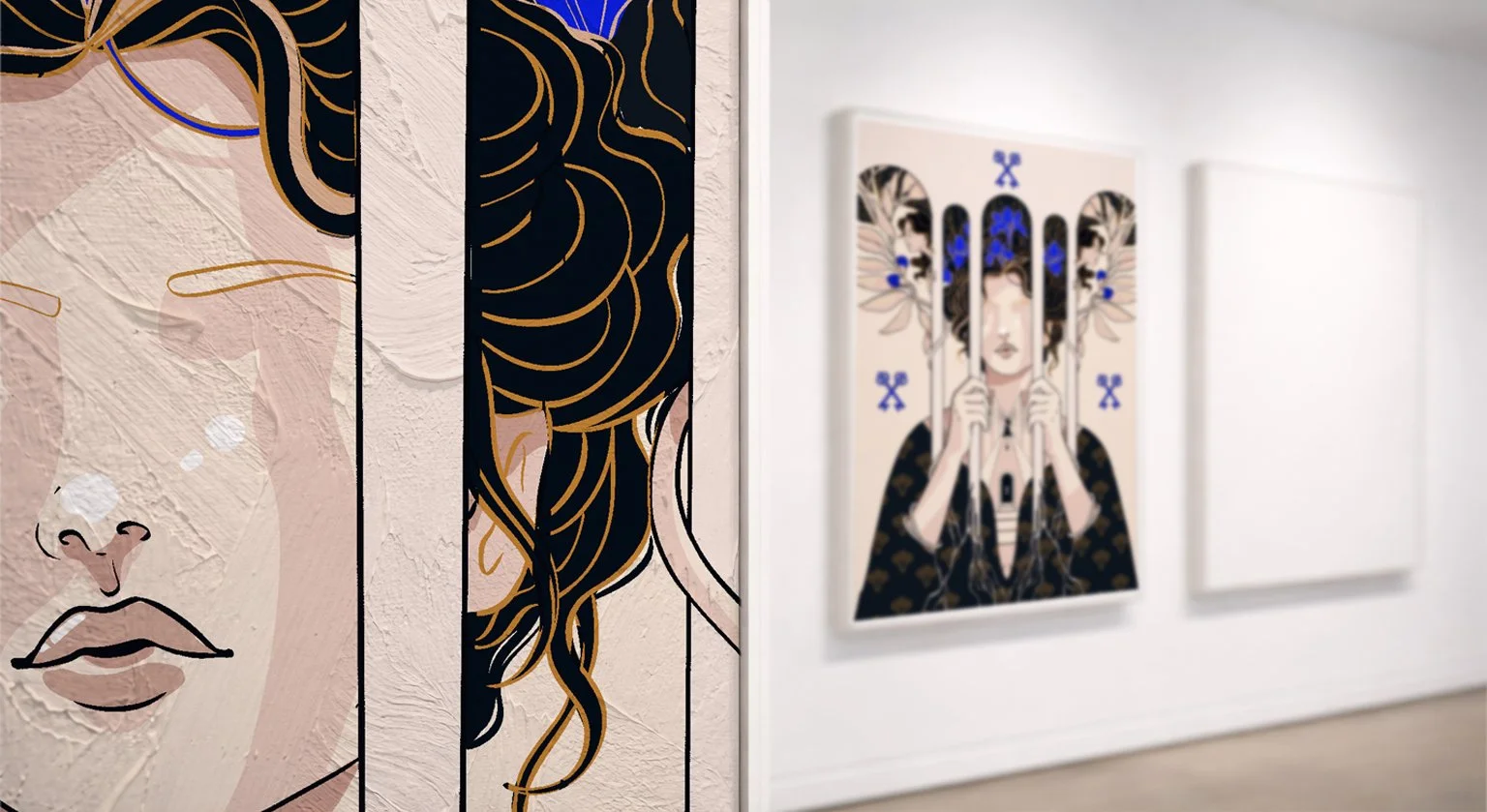
The Garden of Narcissus
The Aesthetics of Warning Signs
Global vision of the project
-
The Garden of Narcissus emerges within a moment when tensions around gender, power, and violence are more visible than ever. On one side, feminist movements are gaining strength—driven by voices that now refuse silence and demand justice, recognition, and social transformation. On the other, masculinist and extremist currents are advancing, reviving rhetoric of domination and feeding a climate in which coercion, intimidation, and violence become instruments of control.
In Switzerland, this fracture takes on a tragic dimension: the number of femicides is rising, while organizations continue to fight for these crimes to be named, recognized, and officially recorded. This lack of institutional recognition renders invisible what is, in fact, a structural reality: the killing of women because of their gender.
This project is born precisely within that tension—out of the urgency to give form, voice, and space to what society still struggles to face.
-
I speak here as an artist—from a lucid, committed position. The Garden of Narcissus is neither a settling of scores nor an accusation: it is an artistic response to patterns of domination and relational violence that run through lives, often behind impeccable façades—yet continue to be minimized, excused, or confined to the private sphere.
This project was born of necessity: to make visible what remains hidden; to give words and form to what corrodes—without sensationalism, without voyeurism. To refuse silence, refuse normalization, and refuse the reduction of these realities to “a couple’s story” or a matter of shame.
I do not seek to answer violence with violence.
My instrument is art: beauty not as a veil, but as a revealer—a way of exposing the real with a calm, precise intensity, impossible to look away from.Through this project, individual and collective experiences become a work: a space for confrontation, memory, and resistance—where we look directly, and where power is reclaimed without noise, yet without retreat.
-
Everything begins with an image deeply embedded in the collective imagination: the myth of Narcissus—so captivated by his own reflection that he forgets the world, forgets others, until he finally drowns in the water he was contemplating. A man undone by self-adoration: a metaphor that resonates with unsettling clarity in certain contemporary dynamics.
From this figure, I move naturally to the plant itself: the narcissus—radiant, seductive, and profoundly toxic. Toxic to those who ingest it. Toxic to animals. Toxic even to other plants: certain varieties release substances that inhibit the growth of what surrounds them. A poison delicately wrapped in immaculate beauty.
This duality—beauty that harms, brilliance that conceals danger—became the project’s backbone. In parallel, another image struck me: that of the perfect garden—the Garden of Eden, or the curated “trad-wife” garden, where idealized women, hair impeccably set, cakes homemade, flowers trimmed to perfection, spend a gardening afternoon as though lifted from a 1950s manual. Behind that overly polished décor can sometimes hide control, the silencing of the feminine, a subtle domestication, an insidious pressure toward perfection—in short, ideal soil in which to cultivate… narcissi.
The Garden of Narcissus is precisely that: the gilded, immaculate, polished image which, beneath its calm surface, can reveal itself to be toxic, dangerous, suffocating. From this shared symbol—the myth, the flower, the idealized garden, the relationships that enclose—dozens of ideas have bloomed. And it is that garden I share here: a garden where each flower reveals what goes unspoken; where each petal shines without masking the poison; where each work questions what we inherit, what we endure, and what we may finally uproot.
-
It begins in 2018, in a tattoo studio. Appointment after appointment, women come to inscribe on their skin a rupture, an exit—sometimes a survival. With the gesture, words follow. The stories return, echo one another, accumulate. Over time, it is no longer a series of isolated accounts: it becomes a pattern. A weight. An echo that embeds itself.
So that these voices would not dissolve—and so that I would not dissolve into them—a black notebook becomes necessary. I gather sentences, silences, fragments. And, after each working day, a few sketches: a way to set things down, to understand, to leave a trace without betrayal.
In 2026, the notebook is there—thick, filled to the edge. It does not ask to be “told”; it asks for form. For transformation. So I choose to move this material into art. Not to remain in accumulation. Not to drown. To turn this excess into a language.
From this gesture, The Garden of Narcissus is born—and the entire exhibition that unfolds from it.
-
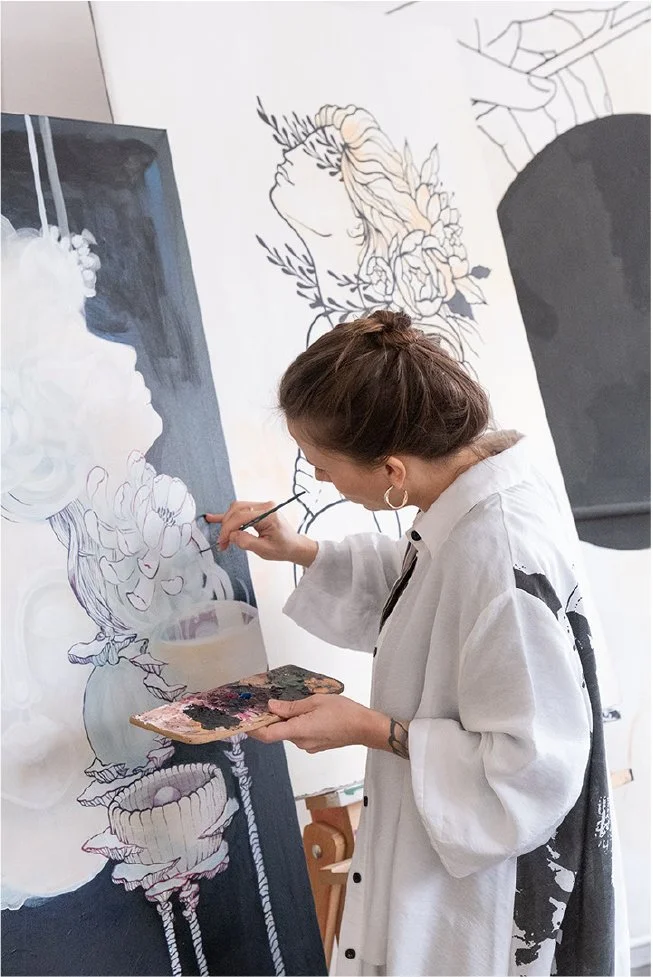
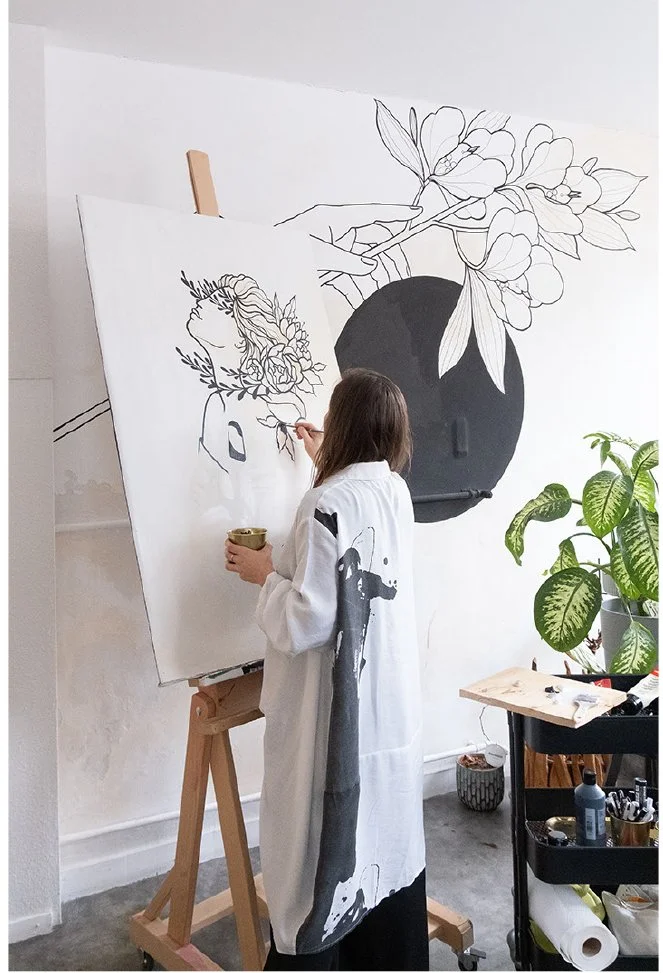
Painting is my first artistic language. The works in this project are both an extension of years of practice and a visual translation of all the voices I have heard. I am drawn to portraits adorned with flowers, symbols, subtle details, and surreal fragments. My precise, meticulous—almost obsessive—line becomes, here, a tool: a way to give a face to invisible narratives.
Each portrait carries the symbolic weight of lived experience: the body, threat, strength, flight, survival. These works do not recount a single story; they embody hundreds of whispers—confidences gathered over the years, and held in the gaze.
-
To move beyond my current skill set, broaden my artistic field, and explore new visual languages, I chose to bring this project to life through installations and sculpture.
The deconstructed Narcissus, the steles, the suspended flowers—each of these works extends the identity of my practice: a dialogue between raw and refined matter, a sustained pursuit of contrast, tension, and contradiction.
Concrete converses with wood, metal with ceramic. These materials become metaphors for our inner structures—education, inherited mindsets, fragility, rebuilding; the dismantling and reconfiguration of the masculine and the feminine.
-
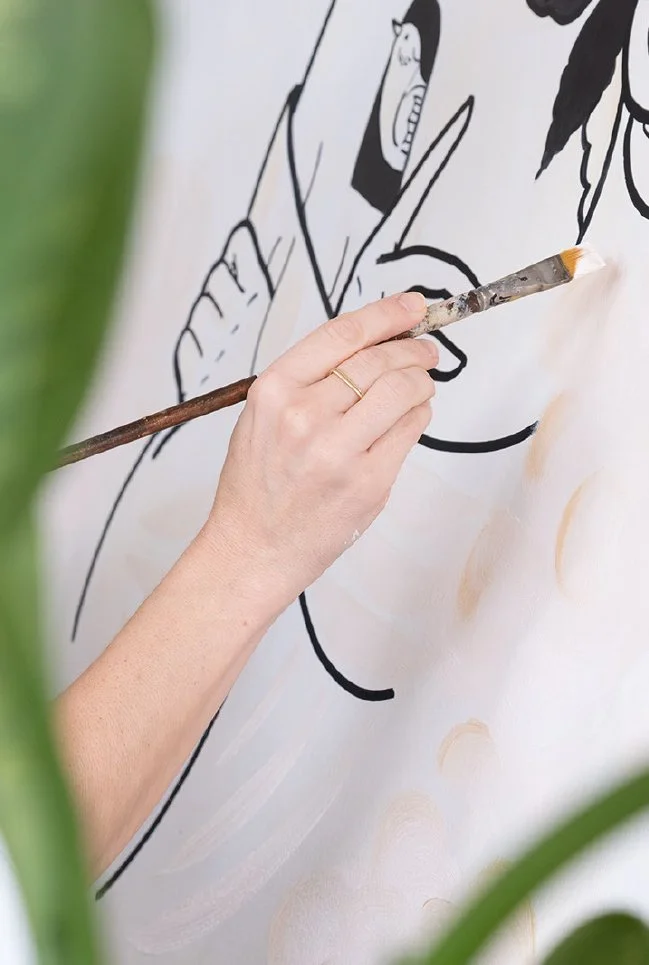
As a multidisciplinary artist, mural work holds a central place in my practice. It brings visibility and scale to the project, allowing the exhibition to move beyond the strict confines of the gallery. The themes I address are universal and global; they belong, quite naturally, in public space.
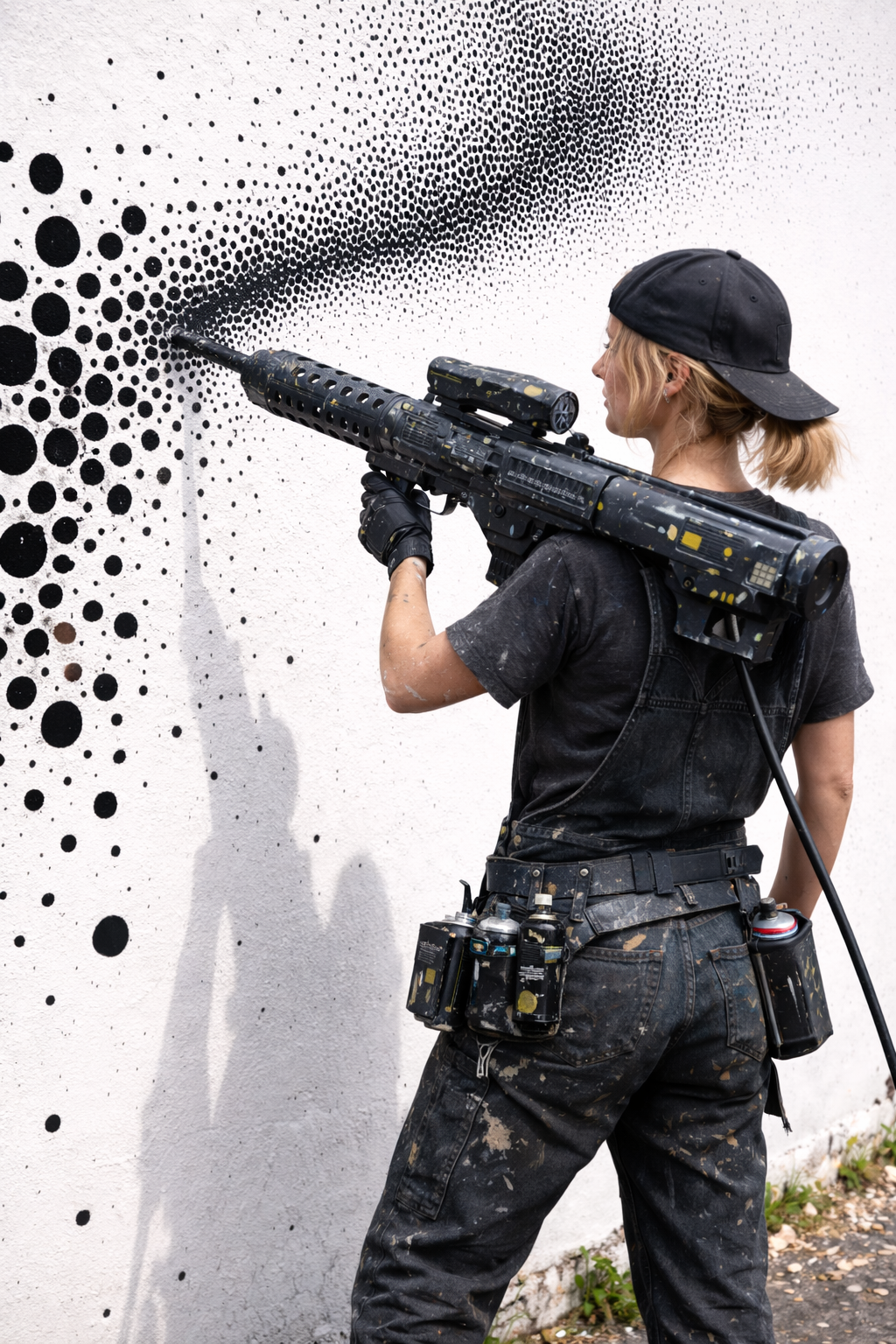
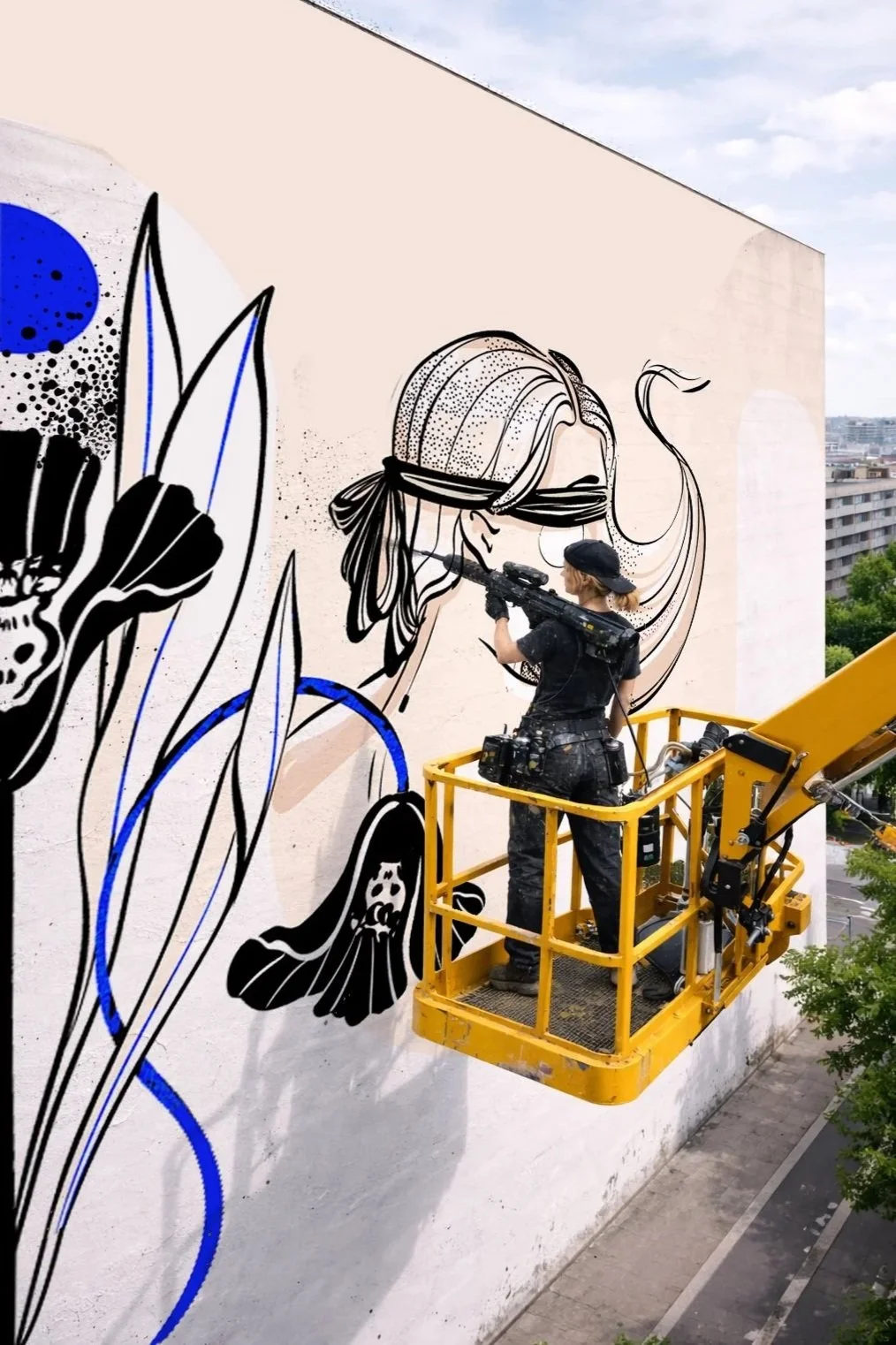
In an urban context, the mural becomes a political instrument, a social act, a stance. To amplify its impact, I developed a “dot-weapon”: a large machine inspired by a firearm, designed to project the points that are usually delicate in my work with force and brutality. This deliberately violent gesture mirrors the toxic masculinity I denounce.
With this instrument, I paint portraits of survivors. The action is brutal, yet the image remains gentle. It is an artistic response to violence—a symbolic reversal.
-
The book is the project’s culmination—the total object that brings all its dimensions together:
sketches from the black notebook,
the ten portraits of survivors,
illustrated poetic texts,
and an original glossary of toxic plants, conceived as metaphors for destructive relational behaviours identified in psychology: gaslighting, love bombing, manipulation, narcissistic abuse, and more.
The book becomes a didactic, sensitive, and artistic tool: an illustrated guide to recognizing the signs of a toxic relationship, understanding coercive control, and protecting oneself.
The poetic interludes will be written in collaboration with the writer Sophie Dora Swan, whose literary world aligns with the project’s delicacy and depth.
-
The Garden of Narcissus exists as much in my imagination as it does in my hands. That is why this page exists—why these texts exist, why I lay the process bare: to share, from this moment onward, the project in its full scope, and to invite others to accompany it toward its final form.
Whatever happens, I will bring this project to completion. The question is not if, but how—and at what pace. Its final form will, of course, depend on the support it receives: financial, institutional, and logistical.
I will allow myself time, but not an endless delay: one year would be ideal; two years remain an acceptable horizon. Beyond that, it would betray the urgency of the subject. Because there is, truly, urgency: the portraits are advancing, the sketches are accumulating, the book is taking shape. Each day, the project grows, germinates, insists on becoming real—within public space, within galleries, and in readers’ hands.
I will move forward step by step, according to responses, opportunities, and the doors that open. At the end of this page, a way to support the project is available. Every gesture matters: it enables a faster realization, a broader scale, and a form more faithful to what the work must become.
If you would like to support this project in any way, please write to me directly: tami@hopfstudio.com
Any support is welcome—truly.The visuals presented here are research images: sketches, compositional tests, material studies, and chromatic intentions. They are not final works, but the foundations of the exhibition’s visual language.
These documents help to situate:
the aesthetic direction (pointillism, relief, ornament, void, fracture),
the staging of bodies and botanical symbols,
the future formats, scales, and dispositifs (paintings, murals, steles, installations).
THE BODY OF WORK
PAINTINGS
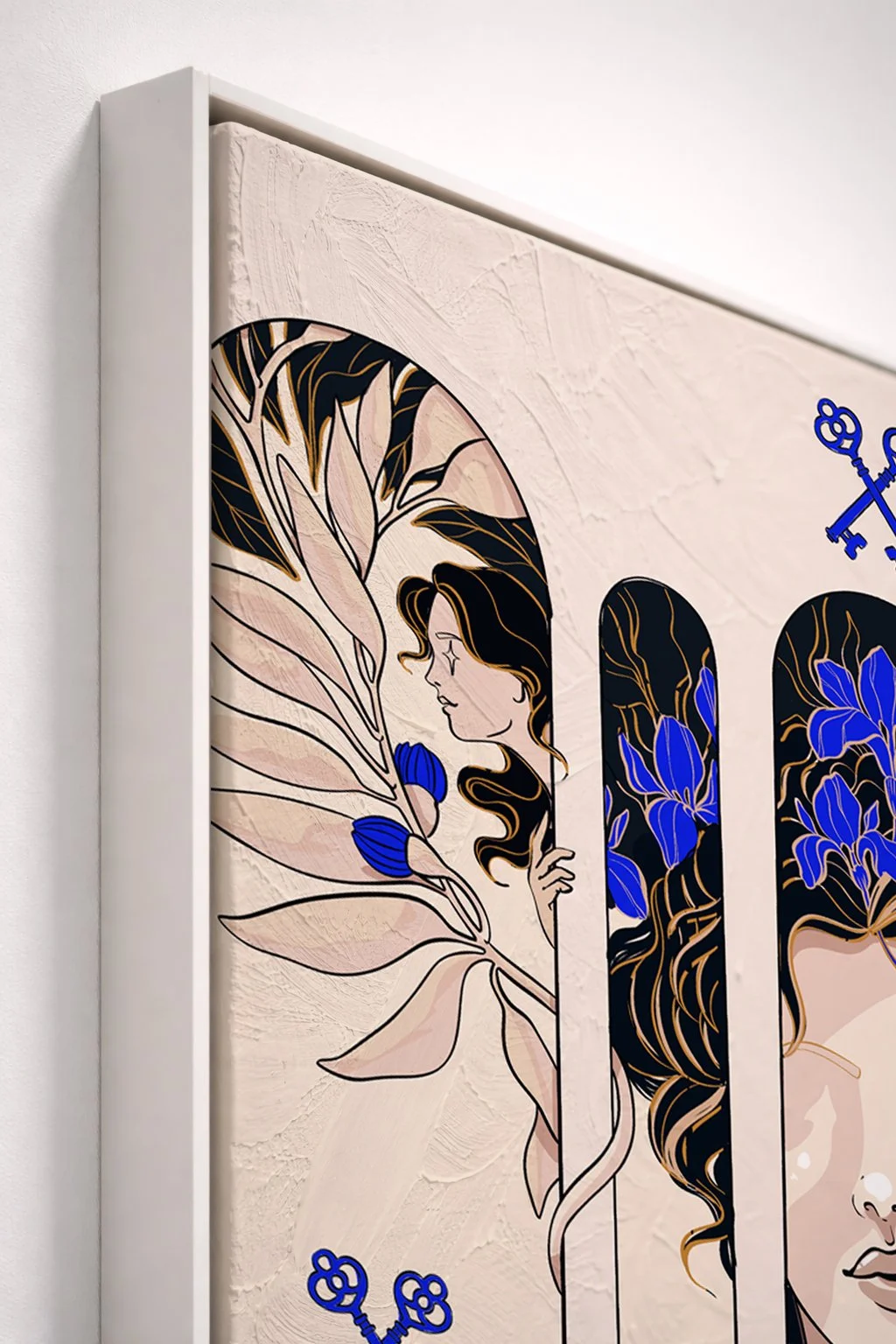
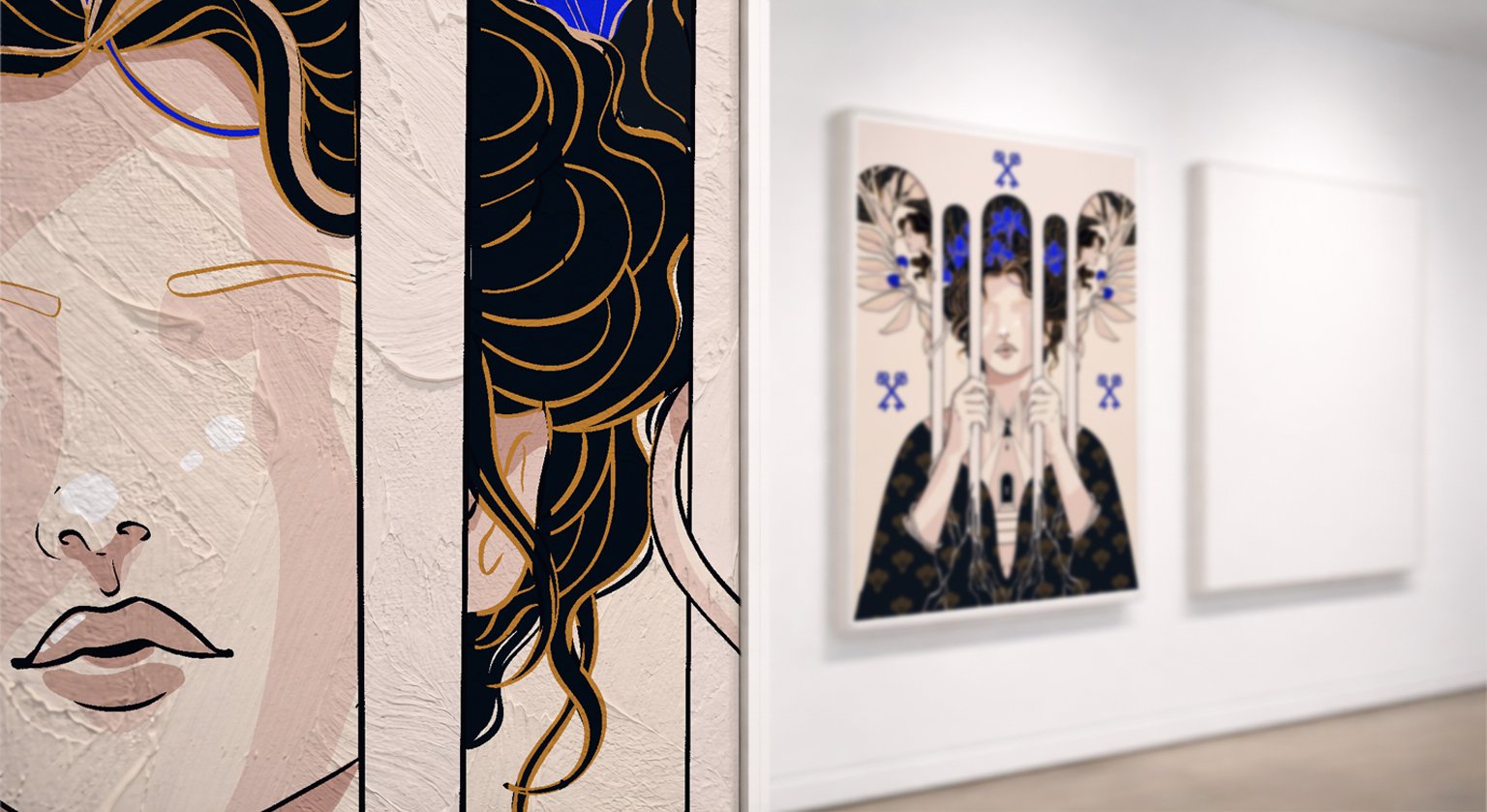
Images illustratives
THE SURVIVORS (studies in progress)
Series of 10 paintings — 100 × 150 cm
Acrylic on wood, gold leaf
These ten portraits give form to a rare and immense act: breaking free from coercive control. Each figure embodies a trajectory of resistance—where determination is not a slogan, but a vital necessity.
The series draws on dynamics of domination identified in psychology—gaslighting, manipulation, love bombing—and sets them in tension with a botanical vocabulary: toxic plants, deceptive blossoms, venomous beauty. This analogy is not meant as literal illustration; it makes visible what, in coercive control, works by infiltration—through charm, through confusion—until the unreal becomes believable.
By allowing seduction and danger, ornament and threat to coexist, these paintings reveal the trap’s ambivalence—and, in counterpoint, the force required to tear oneself away. The Survivors does not merely depict violence: it affirms the solemn beauty of emancipation.
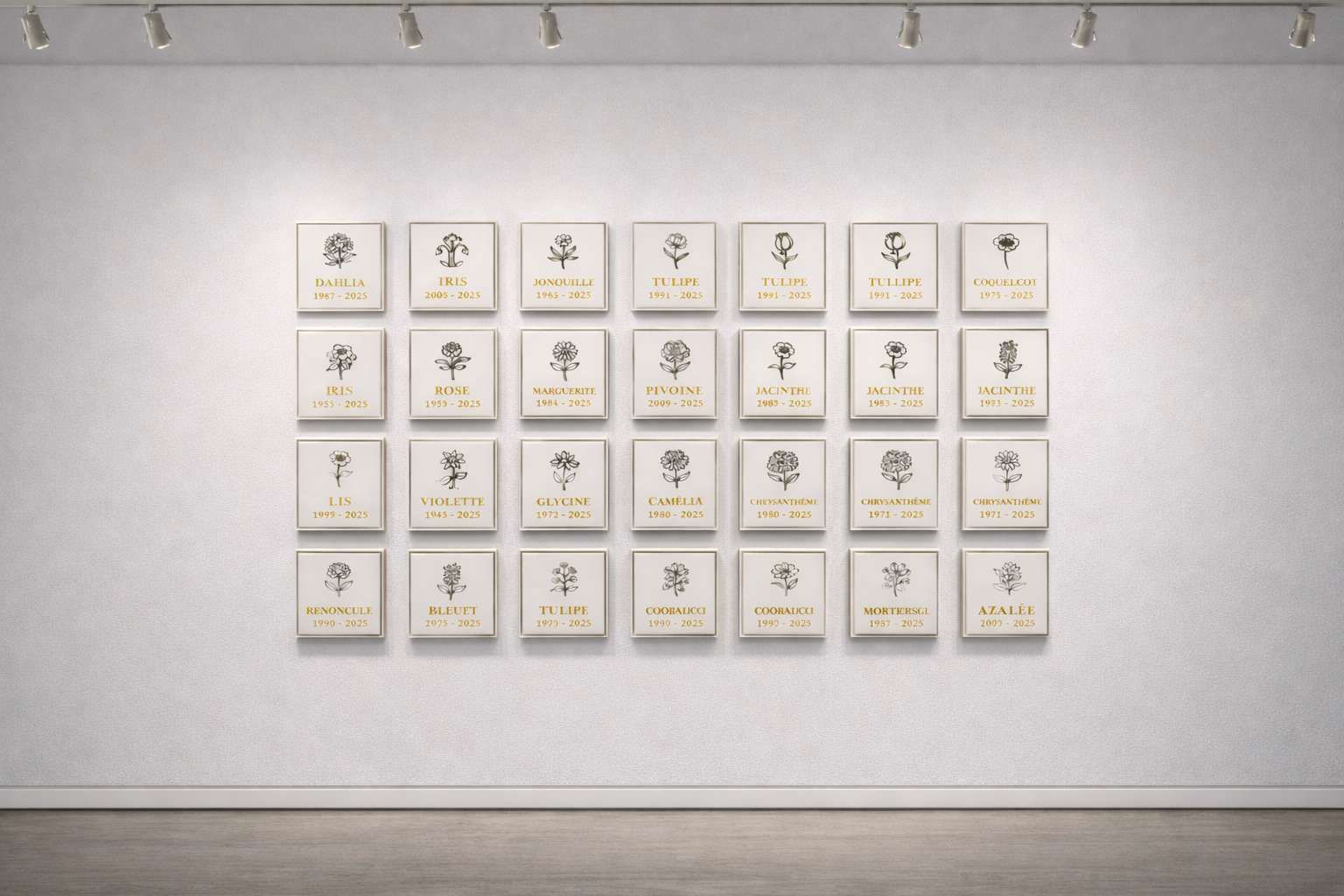
THE ABSENT (studies in progress)
Series of 28 paintings — 20 × 24 cm
Acrylic on wood, gold leaf
In response to the contemporary reality of femicide, this series pays tribute to twenty-eight women—absent from their loved ones, from their children, from their friendships, and from our society.
Each painting presents a single flower, as in a funerary garden. Beneath its name, a span of life is inscribed in the manner of a stele. The final date—2025—returns, relentlessly, as an imposed rupture. Together, the works form a fragmented memorial at human scale, where the image stands in for presence, and silence becomes material.
Through repetition, the series asserts a brutal truth: femicide cuts across every age, every origin, every social milieu. The Absent does not seek spectacle; it insists on the gravity of the fact—and on the necessity of finally looking at what is missing.
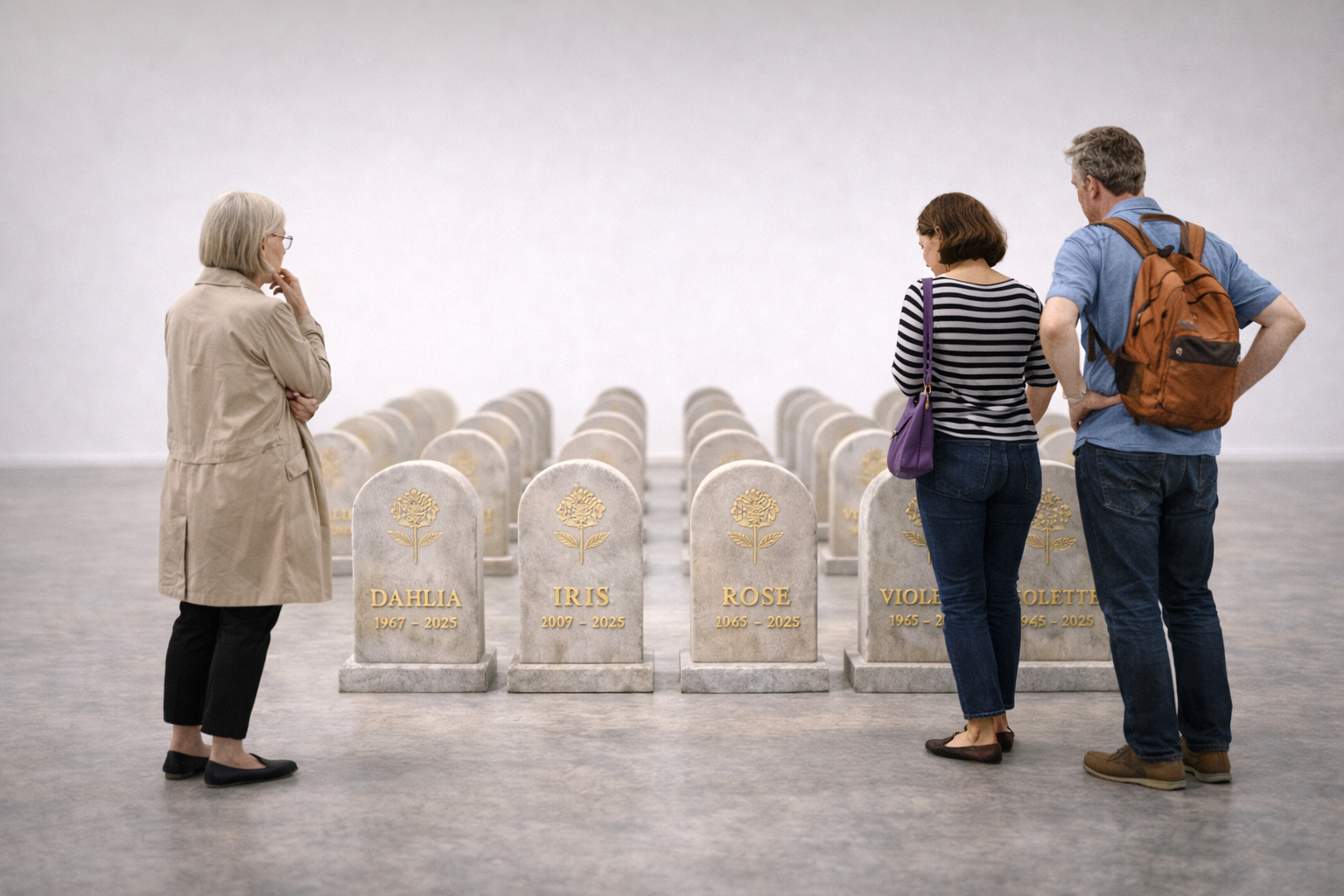
INSTALLATIONS & SCULPTURES
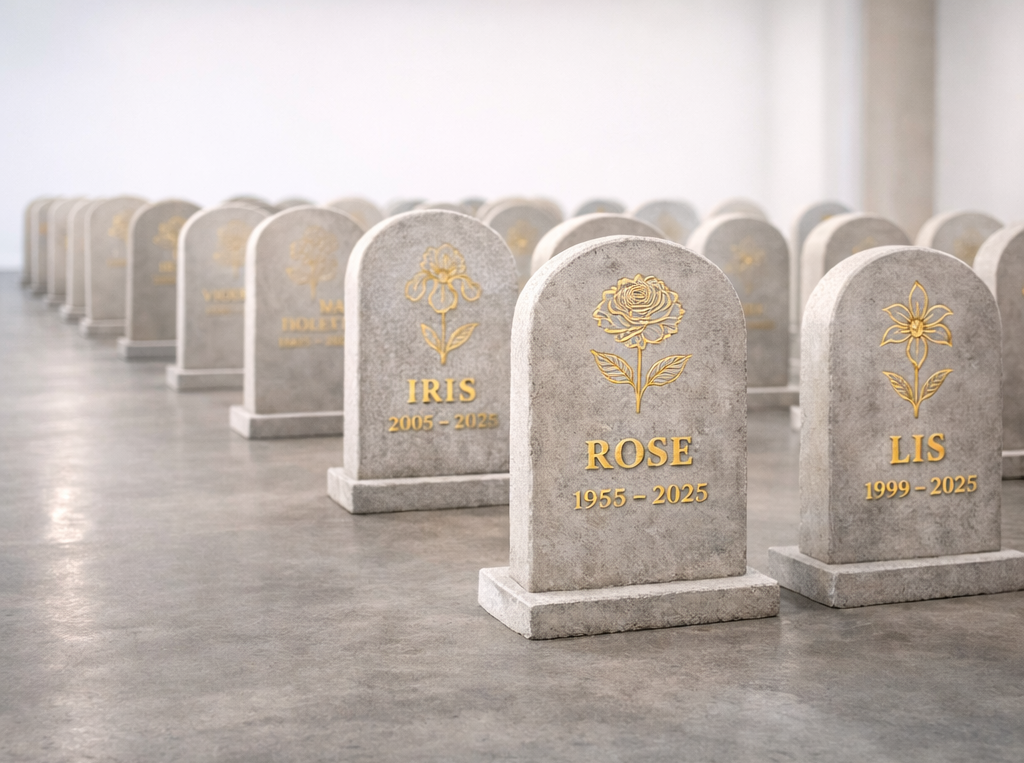
28 TIMES ABSENCE (production pending funding)
Memorial installation dedicated to those who could not escape
Series of 28 steles — 60 × 90 cm
Metal structure, raw concrete, gold leaf
28 Times Absence is a memorial installation dedicated to those whose trajectories were cut short before any possibility of escape. In Switzerland, 28 femicides were recorded in 2025 by the research initiative Stop Femizid, in a context where no single, centralized official register exists to provide a transparent, unified reading of the phenomenon.
Each stele bears a gold-leaf flower, a floral name, and two dates:
a symbolic “birth,” inspired by the earliest historical accounts of femicide,
a death, inscribed month by month throughout the year 2025.
Aligned like a silent field, these steles produce a physical experience of the statistic: here, the number ceases to be a figure and becomes a missing presence. Raw concrete asserts matter—weight, impact, collapse—while gold, in contrast, acts as a border of dignity: not decorative, but funerary. Where some works seduce through beauty, this dispositif strikes through its directness: it does not narrate; it states.
The installation functions as a miniature cemetery: a sequence of irreparable absences which, through repetition, unsettles the gaze. And it is within that tremor—uncomfortable, necessary—that awareness can begin.
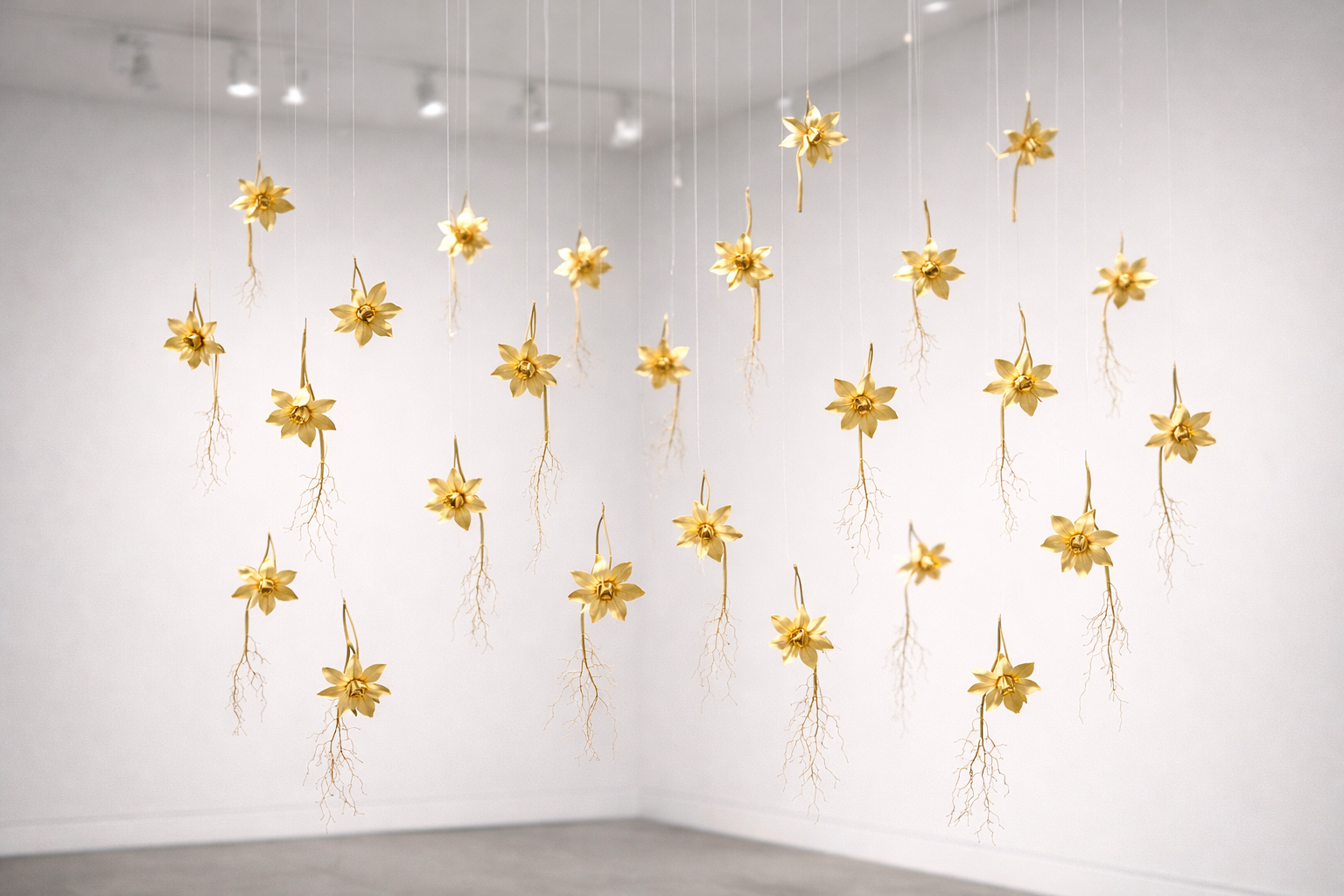
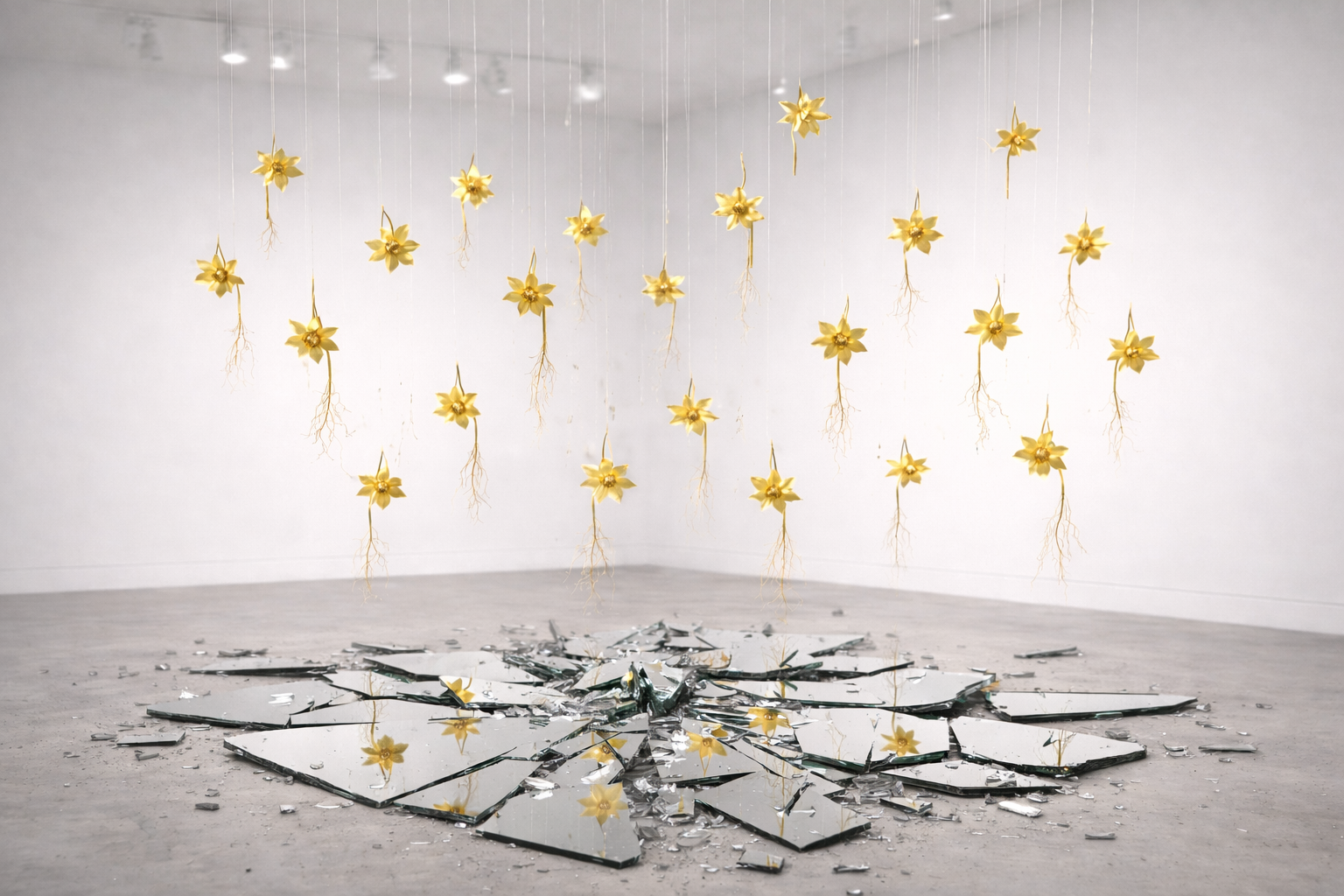
THE REFLECTION OF EMPTINESS (production pending funding)
Suspended installation
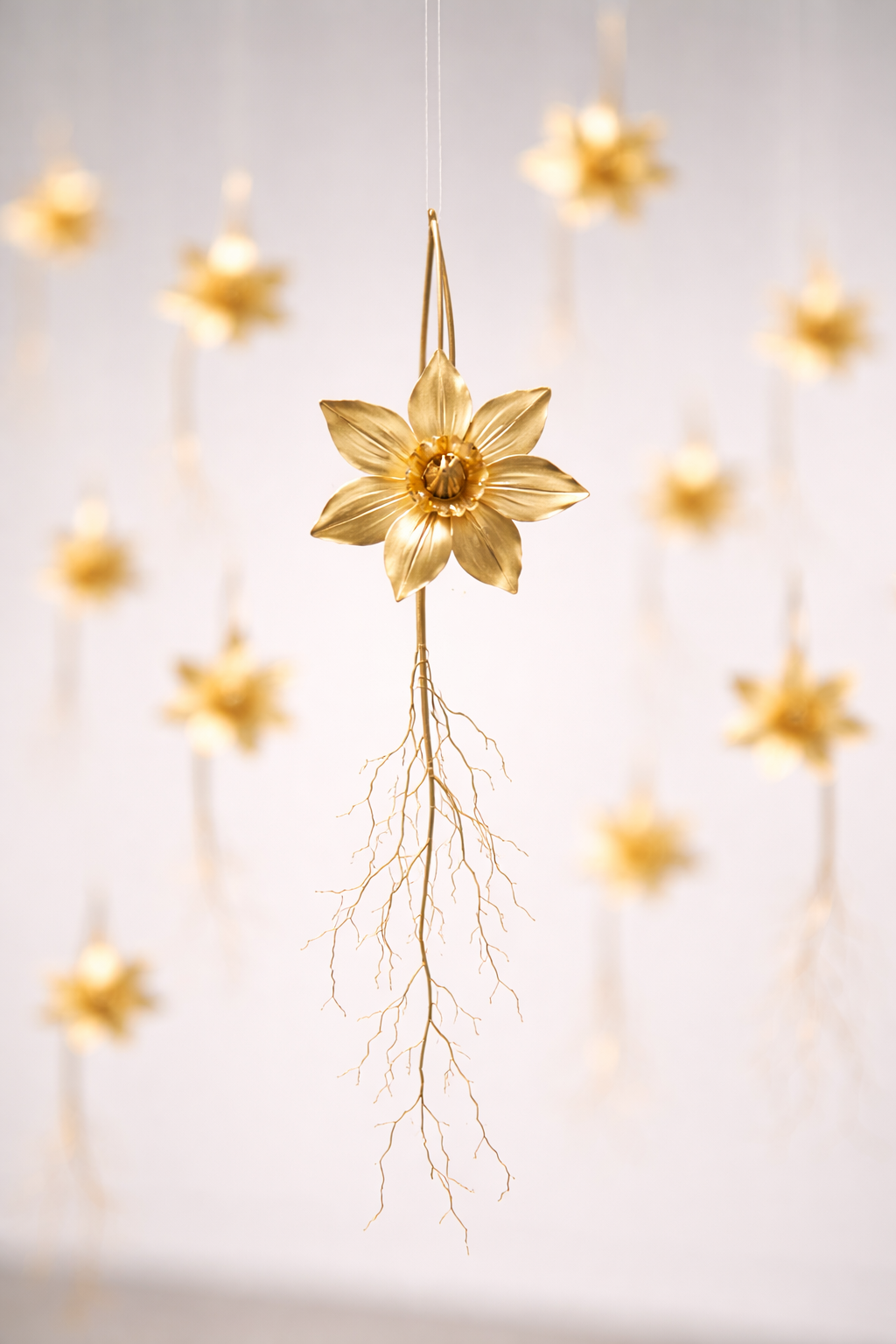
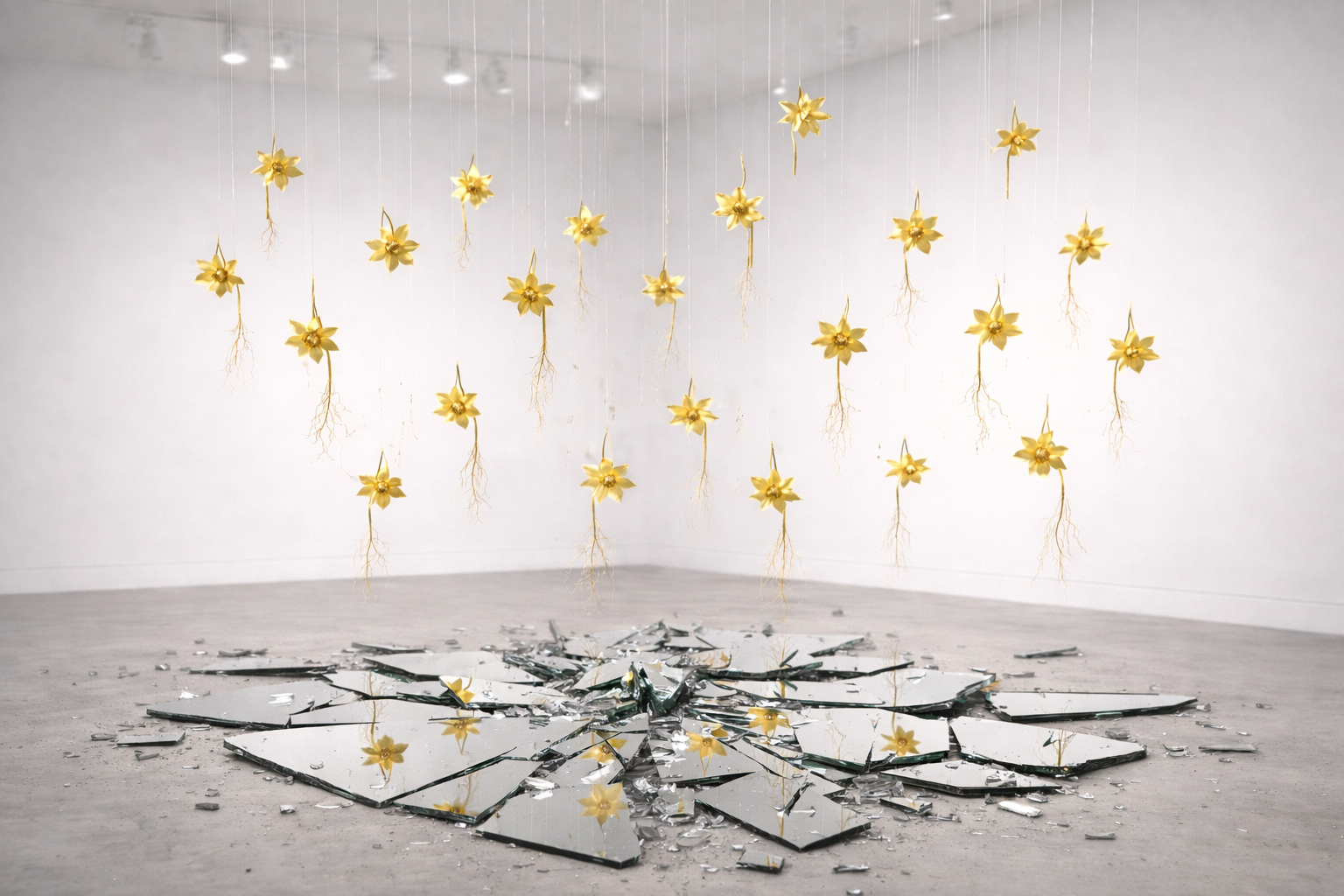
Series of gilded narcissi (imitation gold leaf) suspended in space, with a large shattered mirror on the ground
The term “narcissistic” has taken hold in the public sphere—across media, essays, popular psychology, and especially social networks—until it has become a catch-all word. It is invoked as the symptom of a contemporary malaise: the effects of permissive education, the persistence of patriarchal patterns, or intimate dynamics that still too often reduce women to the role of invisible support.
Drawing on the myth of Narcissus—a figure lost in his own reflection—this installation investigates what is commonly referred to today as “narcissistic abuse.” Not to follow a trend, but to examine how certain forms of relational control take root, become normalized, and shape a daily life in which the other is treated as property, extension, or décor. It brings to light an ordinary, sometimes imperceptible mechanism of domination—one that can lead some men to experience themselves as entitled to their partner.
The suspended narcissi, uprooted, materialize this toxic fascination: flowers that appear radiant, yet are deprived of soil—held in a beauty without grounding, hovering above the void they help to deepen. They evoke the impossibility of loving someone who loves only his own image—and the silent damage such a logic leaves behind.
To uproot these narcissi here is not a moral gesture; it is a symbolic proposition. An invitation to shift the gaze, to name what hides beneath aesthetics, and to question the structures—cultural, educational, affective—that continue to feed these forms of coercive control.
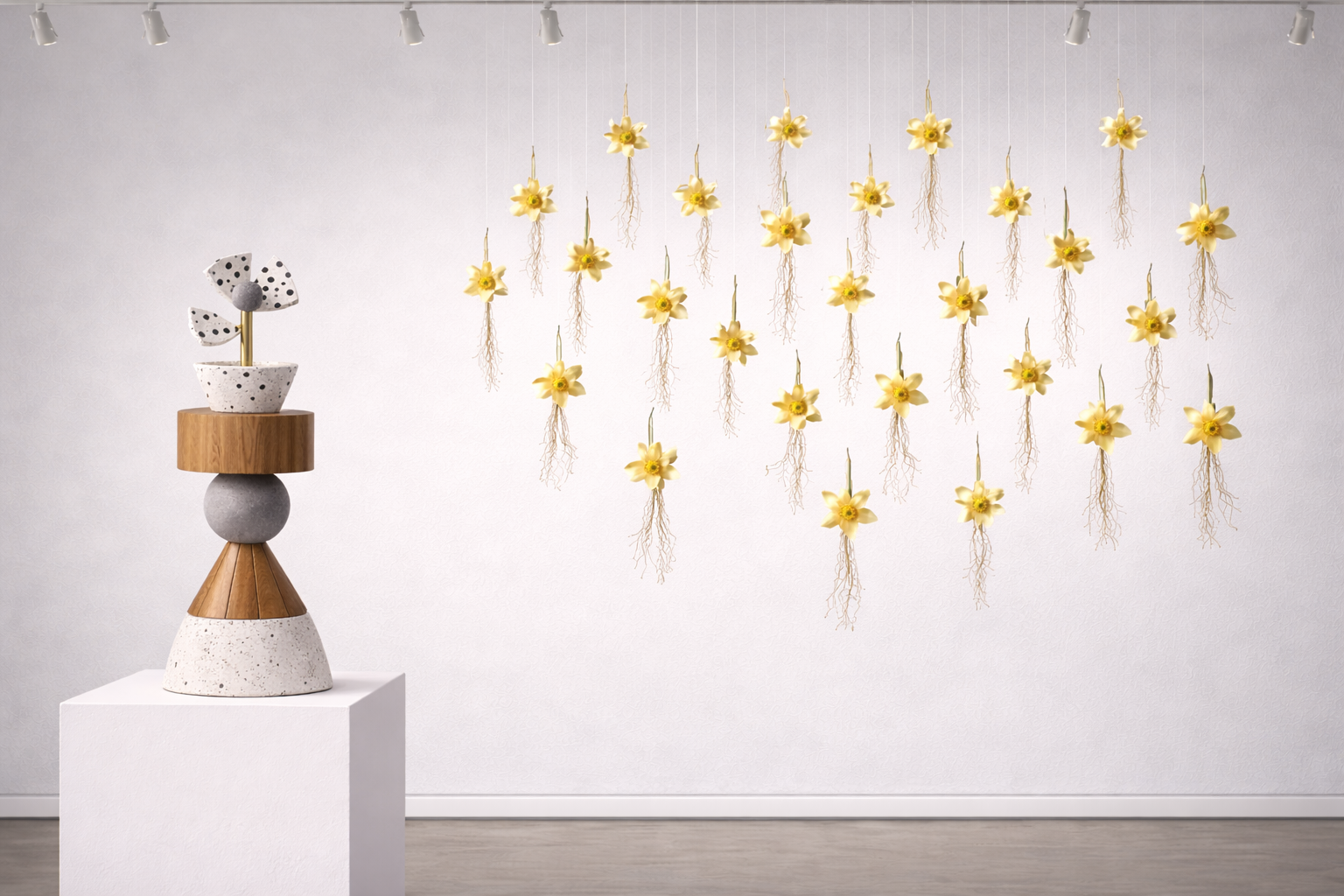
THE NEW MAN (production pending funding)
Sculpture / installation — totem
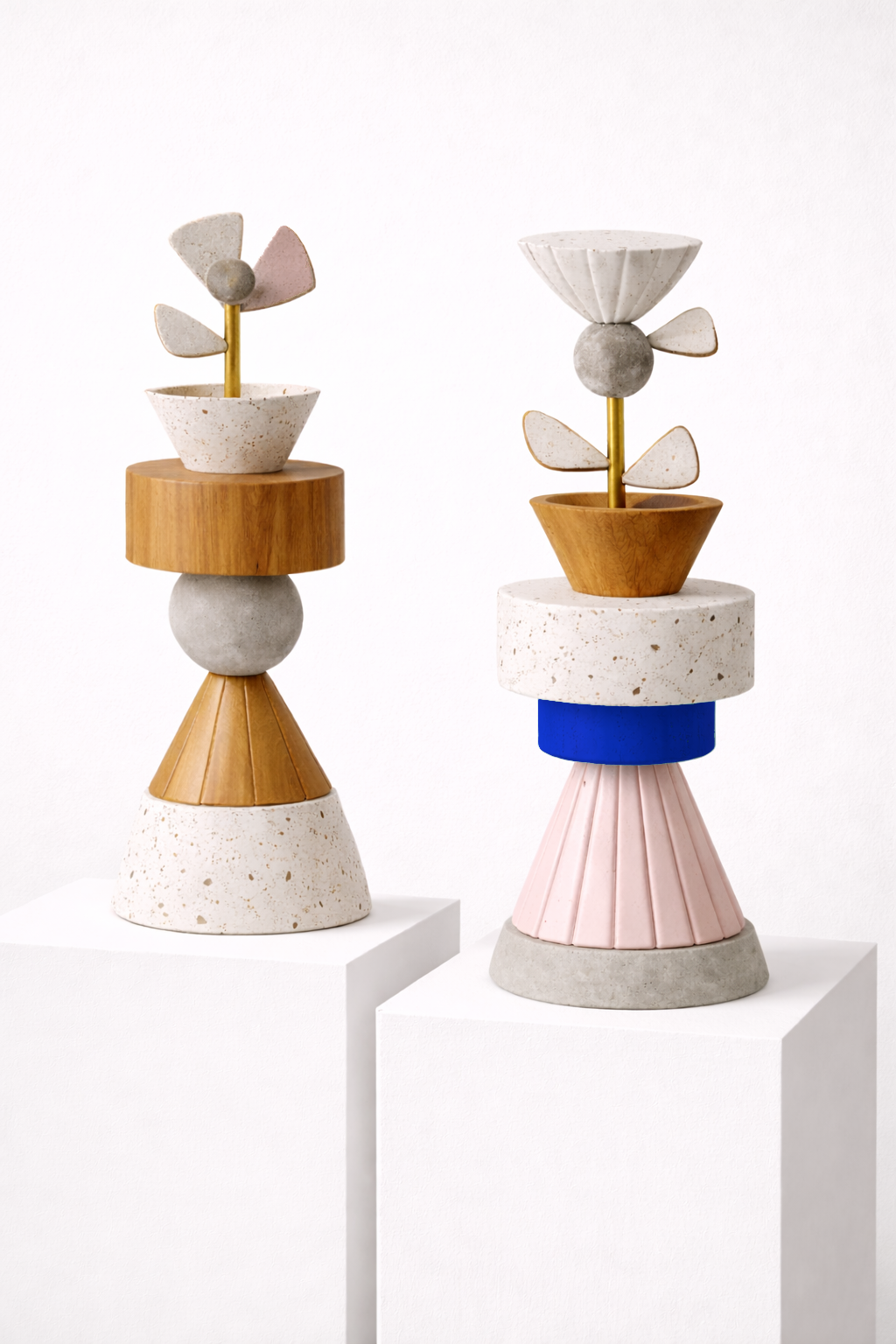
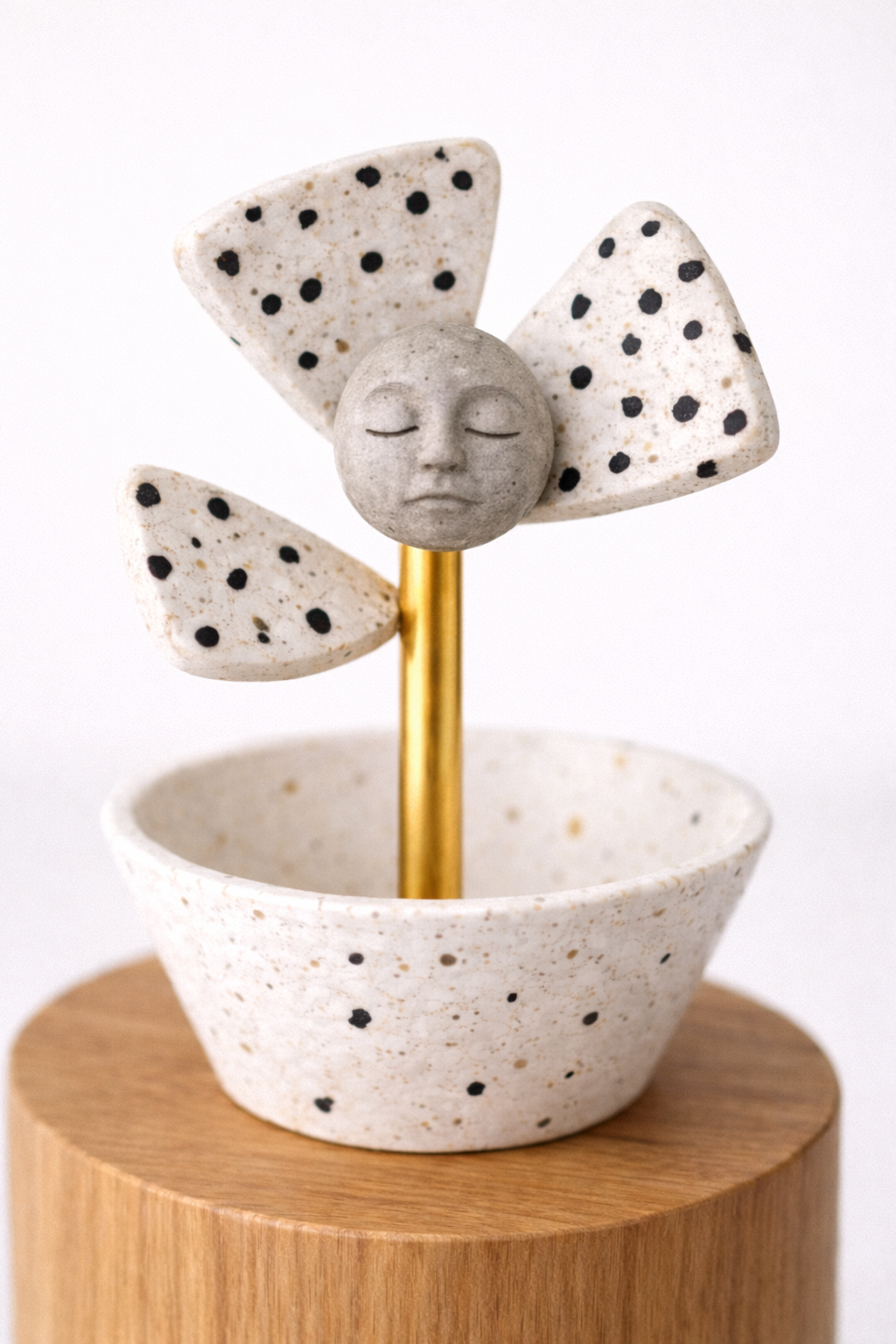
Series of totems composed of mixed materials: wood, concrete, ceramic, metal
The New Man takes as its starting point the polished icon of Narcissus—a figure of masculinity centred on its own reflection, shaped by codes of mastery, control, and performance, sometimes at the expense of the other, and of itself. Here, that image does not vanish: it fractures, shifts, and is reassembled otherwise.
The totem stages a process rather than a result. It gives form to a deliberate dismantling of narcissistic masculinity through a stratification of materials, each carrying a symbolic charge:
Concrete and wood: the foundations—education, inheritance, primary structures; what shapes a man from childhood, often without his awareness.
Metal and ceramic: values and one’s stance in the world—what can bend, be reshaped, be repaired; what learns to reinvent itself without self-erasure.
Delicate forms integrated into the composition: the emergence of an assumed sensitivity; the place of emotions—no longer merely tolerated at the margins, but visible, legitimate, structural.
The work does not idealize a fully achieved “new man.” It embraces the discomfort of construction: a masculinity that accepts its fractures, revisits its foundations, and welcomes vulnerability not as a threat, but as a force of transformation.
PUBLIC SPACE
MURALS
Images illustratives
THE SURVIVORS — MURALS
Survivors’ stories, unfolding in public space
Public or private commissions: art festivals, feminist institutions, cultural venues, municipalities, committed companies.
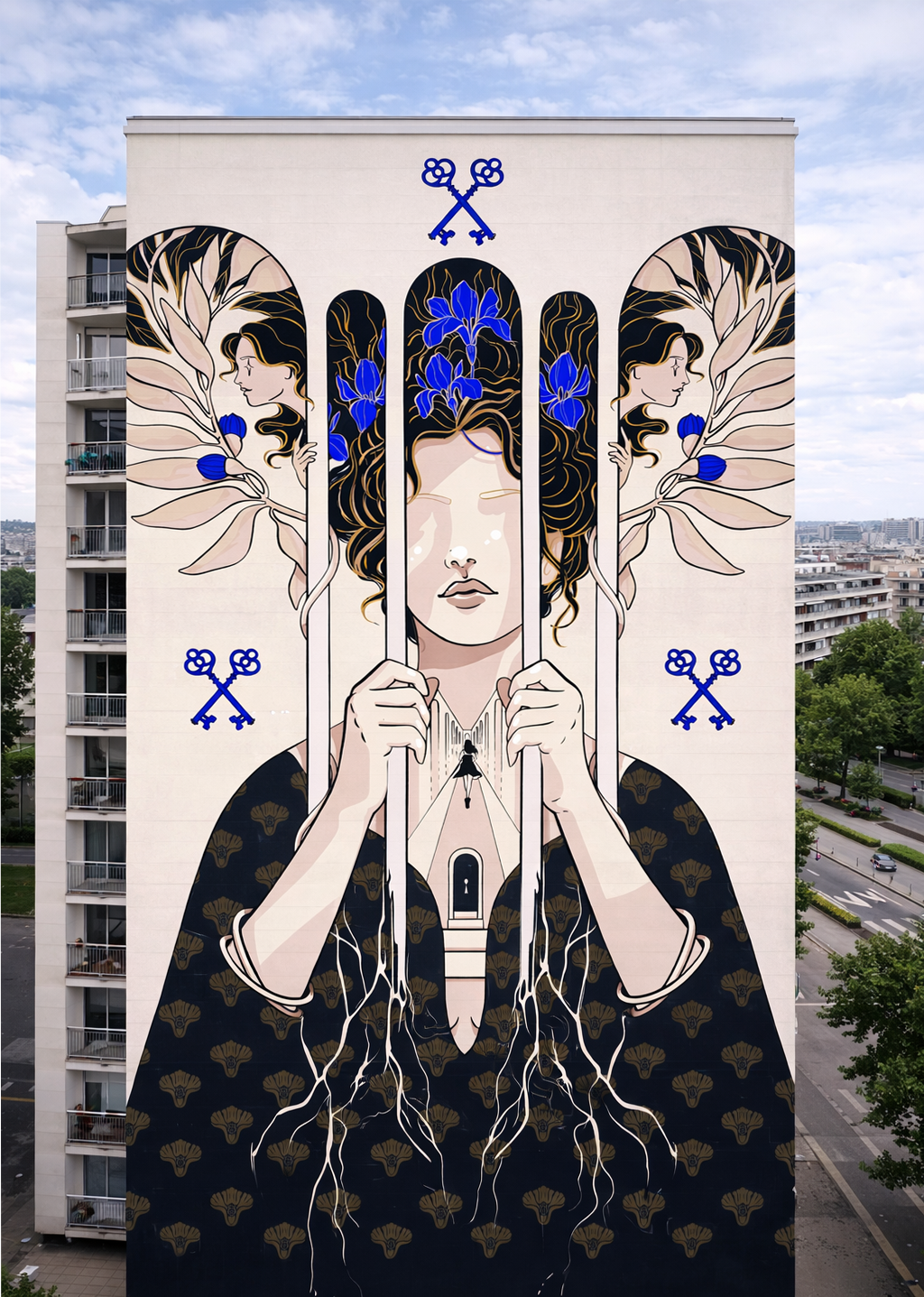
With The Survivors — Murals, the series leaves the canvas format to enter the territory of everyday life: streets, façades, places of passage. Where coercive control often operates in silence—behind doors, in the private sphere—the mural chooses the opposite: to make visible, to name, to open a conversation. In public space, the work becomes a signal. It does not merely represent; it acts as a collective stance against the ordinary violence inflicted on women—the kind that slips into words, habits, excuses, the familiar “it’s not that serious.”
To intensify the impact, each mural includes a performative dimension: the pointillism and the filling-in of bodies are executed using a “dot machine” whose silhouette evokes a weapon of war. The artistic act becomes a symbolic reversal—diverting the imagery of violence, the ultimate emblem of destructive masculinity, to produce an image of resistance, reconstruction, and truth.
Each commission is accompanied by a video conceived as an awareness tool, intended for social media and partners (institutions, schools, associations, media). On site, a QR code integrated into the mural links to the project page: passers-by can access the full story of the depicted survivor, along with concrete reference points to understand mechanisms of coercive control, seek help, and protect themselves.
Example mural title: IRIS and the Lost Keys—a narrative developed in the book The Garden of Narcissi.
WORKSHOPS
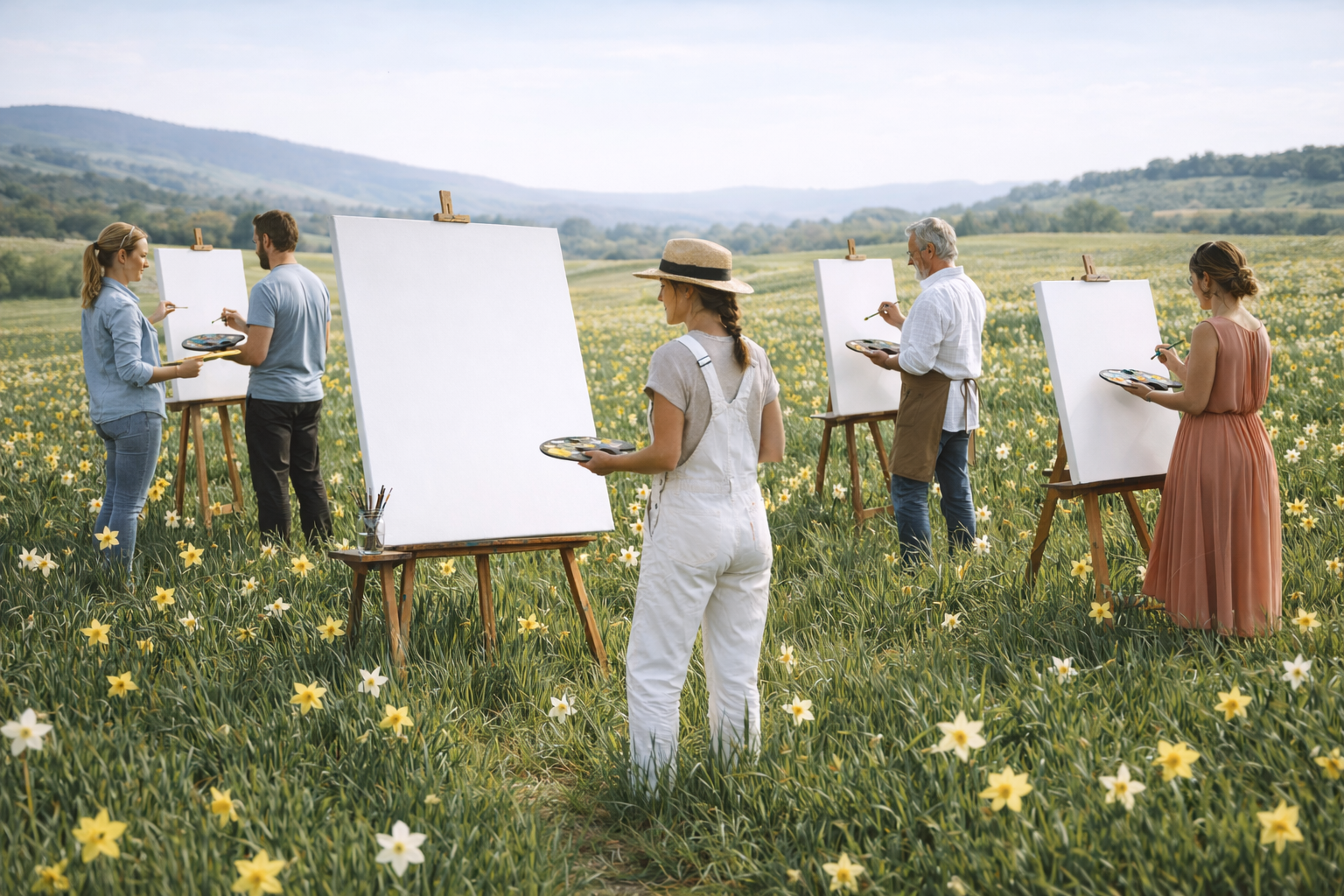
Collective Painting in a Field of Narcissi
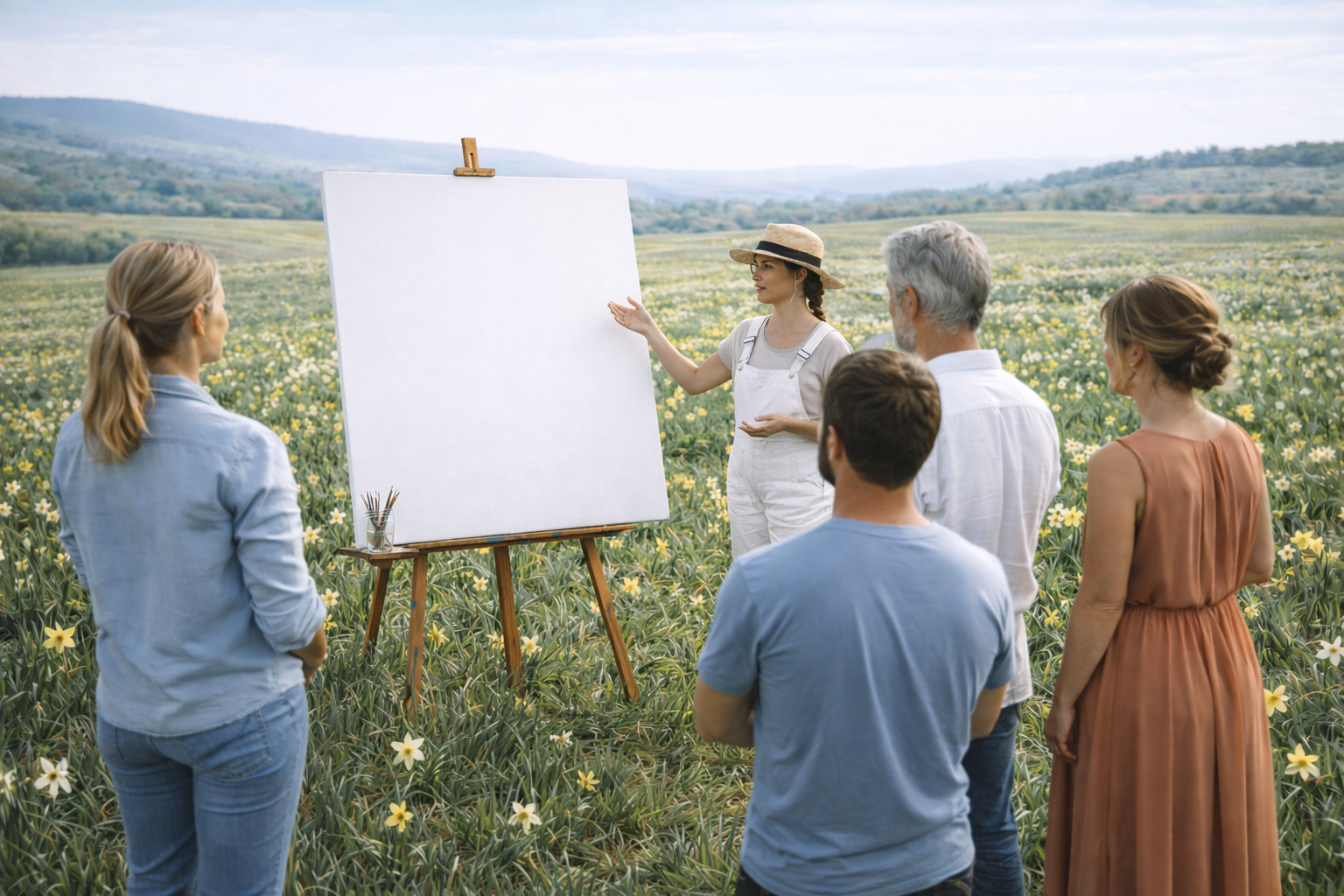
Participatory action / in situ performance
In collaboration with activist collectives
The project is grounded in collaboration with collectives committed to defending women’s rights and combating gender-based violence. Their presence is not a token “show partnership”: it anchors the action in social reality, strengthens its awareness-raising scope, and ensures mediation that is respectful of lived experience.
Collectives considered (to be confirmed):
Les Limaces — La Chaux-de-Fonds (Switzerland)
Surgir — Lausanne (feminist collective engaged against gender-based violence)
Grève féministe Vaud — autonomous political collective
This participatory performance may be documented (photo/video) and integrated into the exhibition dispositif as trace, archive, and mediation tool.
From Mont-Pèlerin to the heights above Montreux, narcissi long whitened the meadows in May—so much so that people spoke of “May snow.” From the late 19th century onward, Montreux transformed this phenomenon into a resource: the narcissus train, bouquets shipped afar (a significant source of income for farmers), and the Narcissus Festival (1897–1957), with its flower-covered floats and performances.
Today, the bloom persists, but the landscape is fading: narcissi are in steep decline (-60% to -80%), under the combined effects of intensive agriculture (early grazing), reforestation, and urbanization. A local association is working to restore their presence in the region—and it is in this context that the project finds its meaning: if “May snow” disappears, what remains of our collective memory, and what do we choose to preserve?
In the fields, three performances will be organized in collaboration with feminist collectives, conceived as moments of public awareness addressed to both women and men around toxic relationships. The audience, positioned at a distance, will be invited to take part in a guided creation: reinventing the image of the narcissus alongside the artist, following a simple protocol (gestures, composition, materials). These shared art moments will bring a local symbol—the narcissus—into dialogue with an intimate and social reality: what appears beautiful, yet can wound.
The works produced through these workshops—together with the project’s pieces—will be presented at Hopf Studio in autumn 2026, in an exhibition accompanied by a public opening.
PUBLICATION
THE BOOK
THE GARDEN OF NARCISSUS
Illustrated narratives from a tattoo studio
Format
A hybrid book combining short narratives, poetic interludes, and original illustrations, with a documentary / educational section (key reference points, concepts, resources).
Genre / Tone
Contemporary narrative nonfiction. An intimate, lucid voice—at times unflinching—held upright by an irony that stays standing when everything else begins to collapse.
Themes
Coercive control and everyday psychological violence · mental load · motherhood · the patriarchy of ordinary life · reconstruction · skin and tattooing as symbolic territories.
Audience
Readers of contemporary literature, women’s narratives, and hybrid text-image forms. A socially engaged audience, without the expectation of a “victim testimony.”
Distinctive Angle
A tattoo studio as a theatre of confidences. Through clients’ requests to inscribe on their skin the exit from a toxic relationship, a collective mechanism of coercive control gradually emerges—until the author understands she must write in order not to dissolve into it.
Botanical Glossary
Plants as interpretive keys: a living vocabulary that renders visible the mechanisms of coercive control (gaslighting, love bombing, guilt-tripping, manipulation, manspreading, etc.). Deceptive beauty, discreet toxins, invasive roots: botany becomes an instrument of understanding.
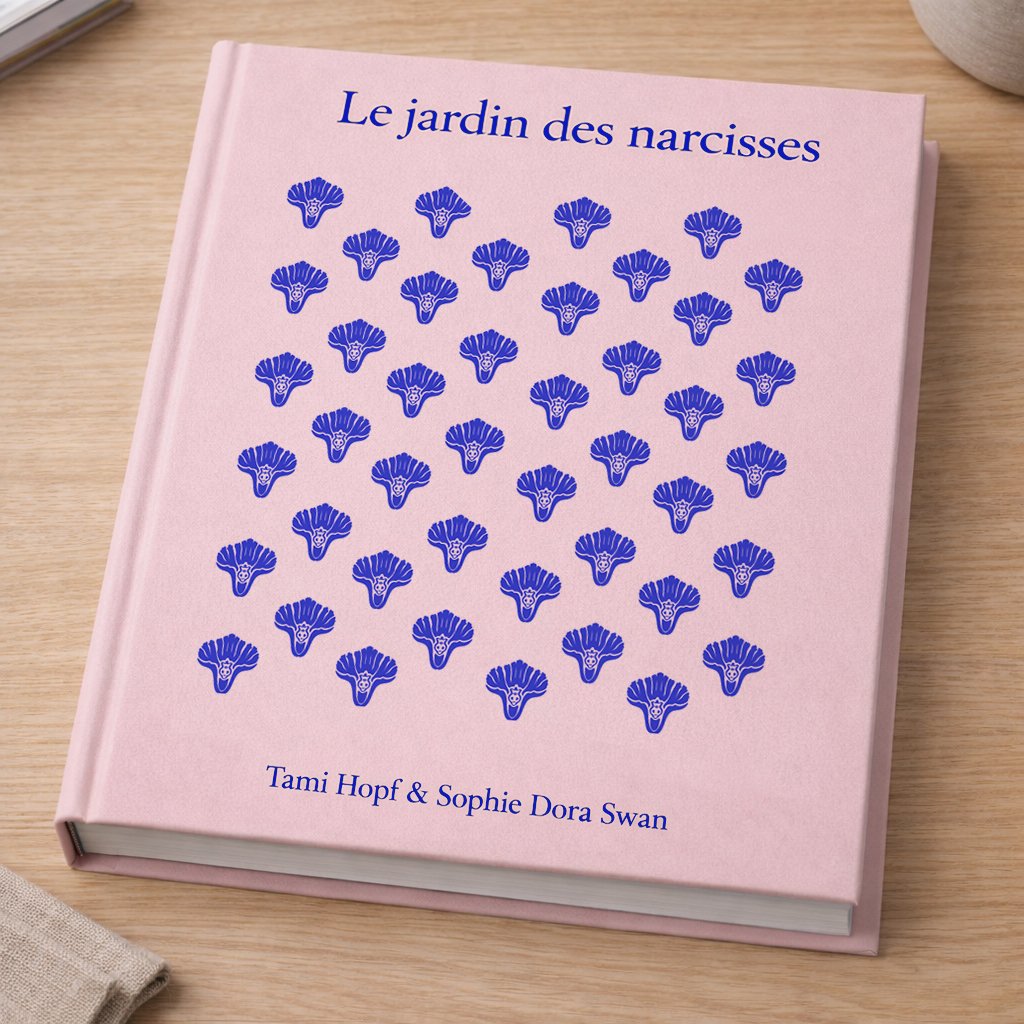
Illustrative Images / Studies in Progress
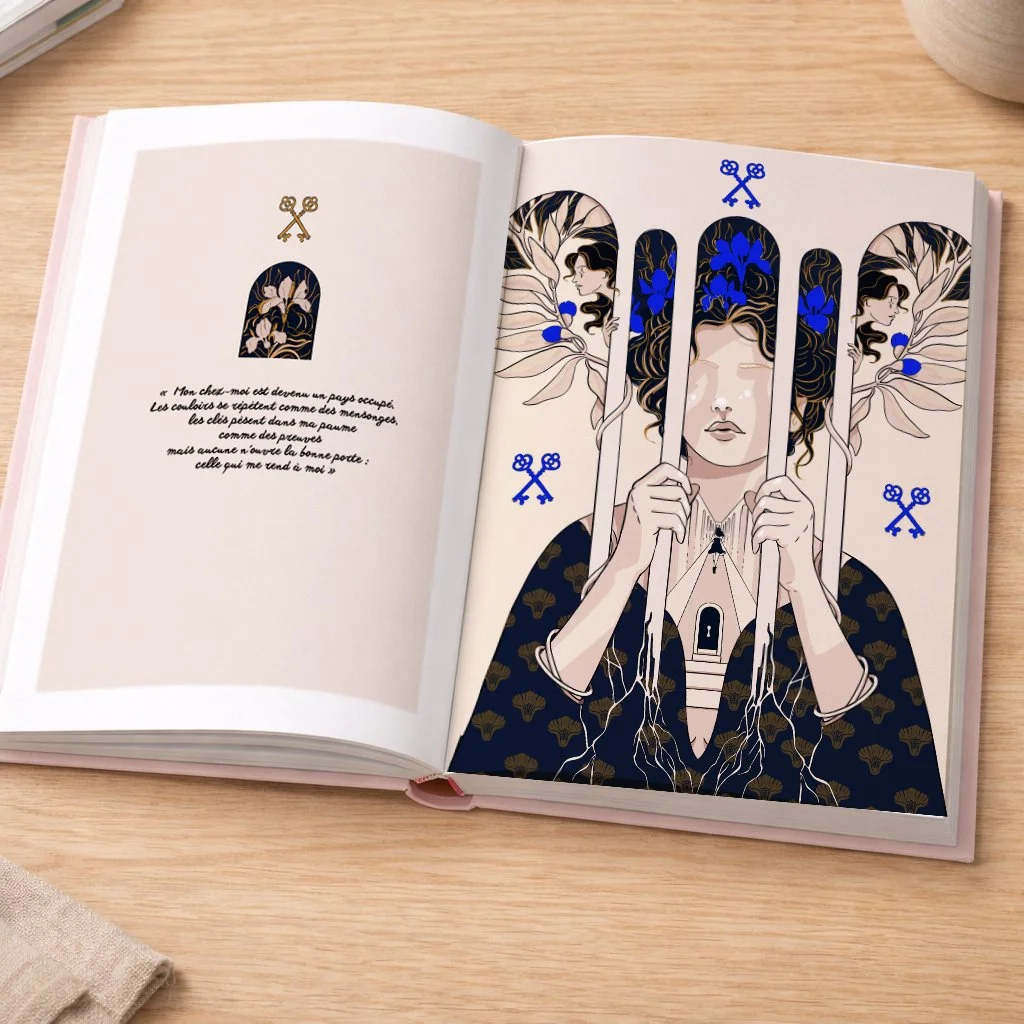

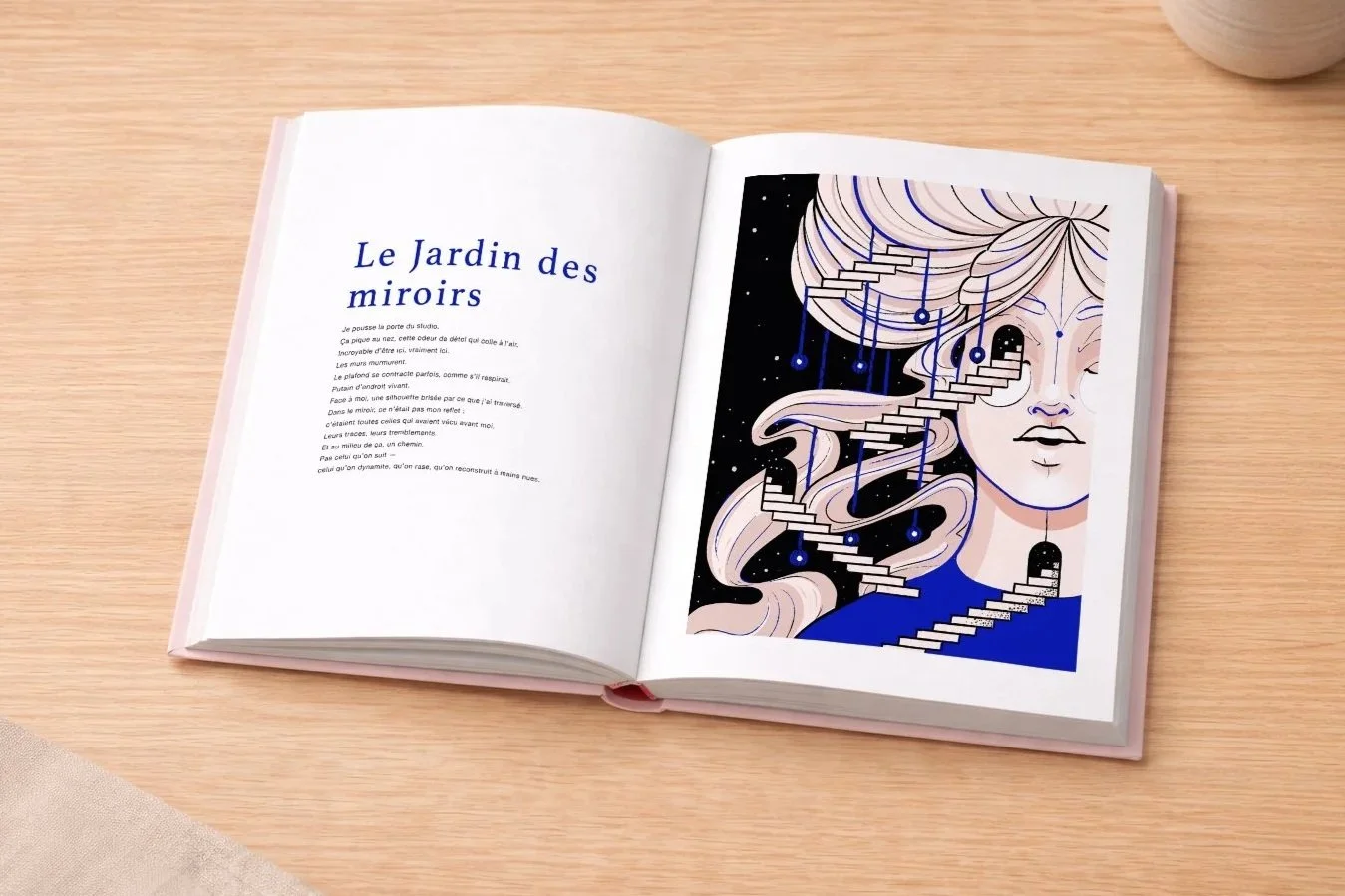
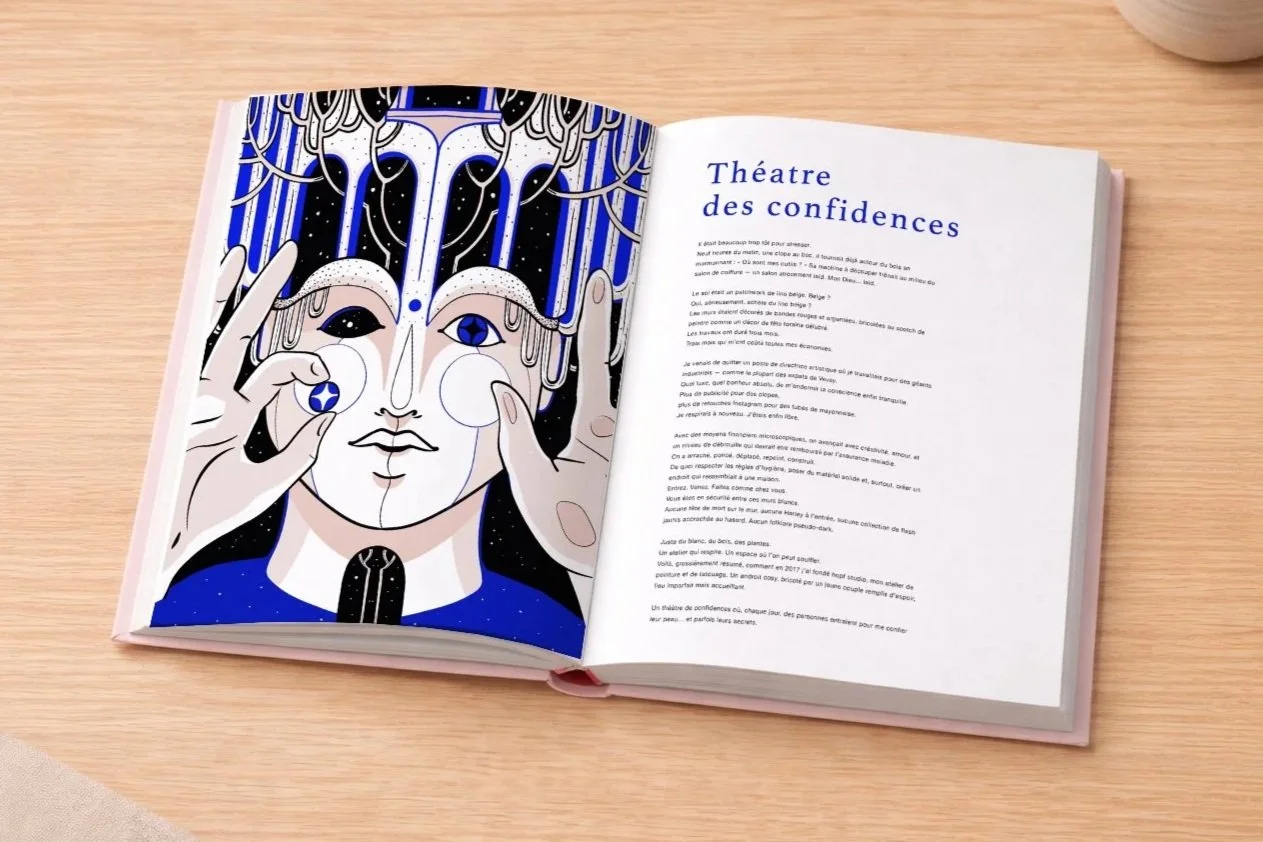
THE GARDEN OF NARCISSUS — Project Statement
“This book is not a confession.
Even less a revenge.
It is a delicate autopsy
performed on women who are very much alive.”
We enter through a studio that smells of disinfectant—through bodies that have taken too much, through a mirror that never reflects a single face. We move through motherhood as one moves through a country at war; through couplehood as through a loss-making enterprise; and through love as a promise too often mistranslated.
The narrator writes from the aftermath: not from the open wound, but from the scar—one that still itches when it rains.
The stories unfold in fragments. The language is precise: sometimes hard, often ironic. Humour appears where it is least expected. Surrealism surfaces when reality grows too heavy: a ceiling begins to breathe, a body negotiates with cold water, a butterfly finally pries its wings free.
The book speaks of mental load, of economic promises, of ordinary patriarchy—the kind that does not shout, but wears you down. It also speaks of rebirth, without forced lyricism: here, one does not “heal.” One learns to walk differently.
It may look like an intimate narrative, yet it is a political text at skin level.
Nothing is resolved. But everything is named.
And sometimes, naming is enough to reclaim power.
Beyond its social context, The Garden of Narcissus is a visual and living experience: where private stories step into public space, where plants speak with bodies, and where beauty becomes the doorway to what we too often refuse to see.
Through paintings, installations, and sculptures, the project turns memory into action—here and now. Not to “state” the problem, but to transform how we look, and how we respond.
Supporting this work means backing a necessary artistic gesture: one that creates a pause, sparks awareness, and shifts the viewer’s gaze—quietly, but decisively.